
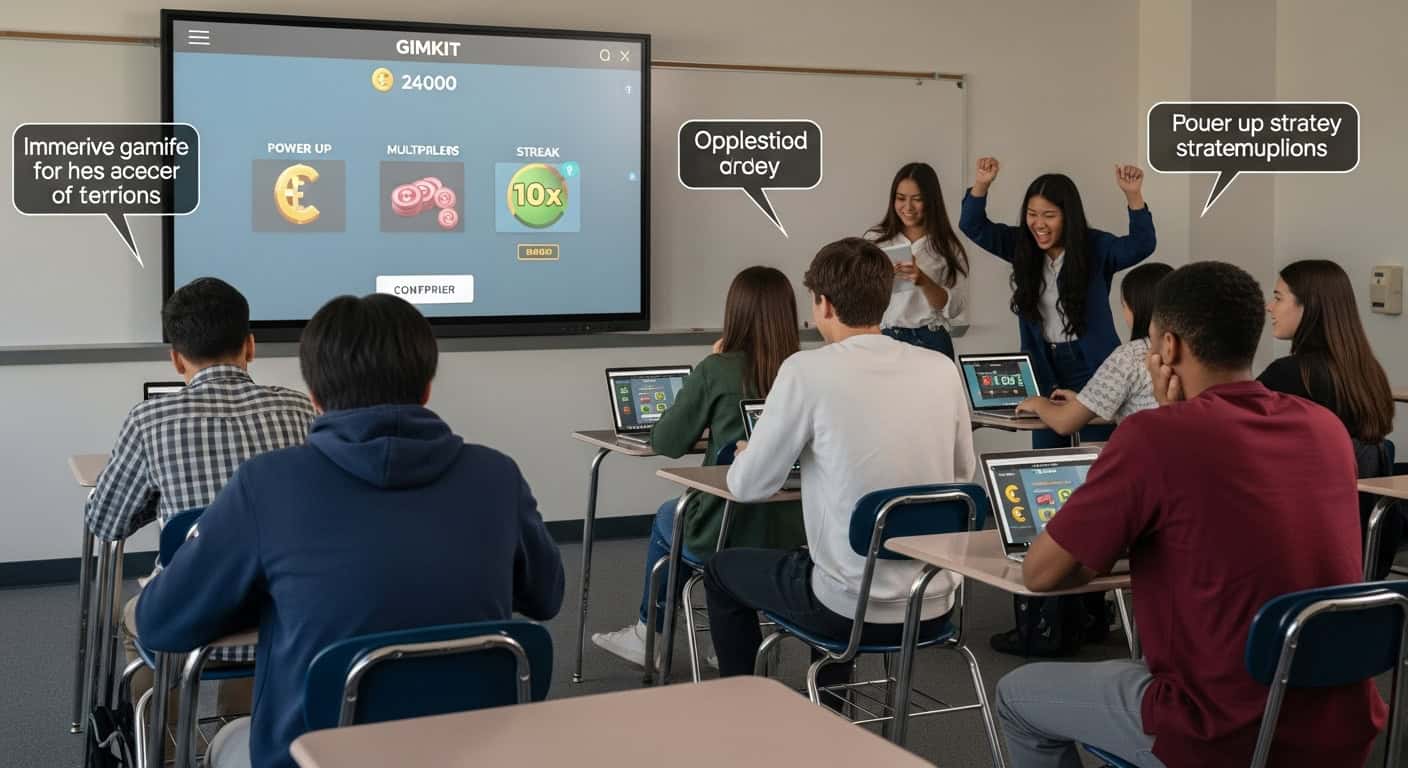
An experienced educator’s in-depth analysis of how this game-based learning tool consistently outperforms every alternative
By fastlane8845@gmail.com
Updated: January 30, 2026
A Decade of EdTech Failures Led Me to One Unshakable Truth
Since beginning my high school teaching career in 2012, I’ve experienced the complete lifecycle of nearly every major educational technology platform. Kahoot captured attention then lost relevance. Quizlet Live sparked momentary excitement before disappearing. Nearpod became prohibitively expensive. Pear Deck cycled through mandatory adoption and swift abandonment. Dozens of district-approved tools now sit untouched in forgotten bookmark folders.
Through all of this, Gimkit has remained permanently open in my browser.
Not weekly. Not occasionally. Every single week without exception, and frequently every single day.
The reason isn’t feature superiority or technical perfection. The reason is straightforward and profound: Gimkit is the only educational tool that reliably transforms thirty disinterested, device-dependent teenagers into passionate learners who plead for additional playing time when the period ends.
After conducting thousands of Gimkit sessions spanning more than twelve years of classroom instruction, this comprehensive breakdown explains precisely why nothing else achieves comparable engagement results.
Table of Contents
- The Virtual Economy That Mirrors Gaming Psychology
- Continuous Feedback Loops That Sustain Attention
- Healthy Competition That Reaches Every Student
- Spontaneous Collaboration Without Artificial Structures
- Meaningful Analytics That Drive Academic Growth
- Universal Accessibility Across All Student Profiles
- Transparent Limitations Worth Acknowledging
- The Classroom Moment That Proved Everything
Gimkit’s Virtual Economy Taps Into the Same Psychology That Keeps Students Gaming for Hours
Moving Beyond Simple Point Systems
Every conventional quiz platform operates identically: answer correctly, receive points, repeat.
Gimkit fundamentally reimagined this model by introducing a functioning virtual economy where students earn currency, make strategic purchasing decisions, and deploy power-ups that materially alter competitive outcomes.
This architectural shift from passive point accumulation to active economic participation changes absolutely everything about student motivation and sustained attention.
Evidence From My Own Classroom
Consider this scenario that played out during second semester:
A sophomore who had systematically failed every assessment throughout first semester suddenly invested twenty-five uninterrupted minutes answering curriculum questions. His objective wasn’t academic improvement. His objective was accumulating enough virtual currency to purchase a 10x multiplier and defeat his closest rival by $3 million.
Final result: forty-seven consecutive correct answers.
This identical student had informed me during September orientation that he “just doesn’t do school.”
He wasn’t pursuing better grades. He wasn’t seeking teacher approval. He was chasing bragging rights and virtual wealth within a system that made learning feel indistinguishable from gaming.
Rapid-Fire Feedback Loops That Mirror Social Media Engagement Patterns
Understanding Why Traditional Review Tools Lose Attention
Standard educational review games provide isolated feedback moments. Students answer a question, receive a binary correct-or-incorrect response, then wait for the next prompt. The engagement gap between these moments creates space for distraction, disengagement, and device switching.
How Gimkit Eliminates Dead Space
Gimkit delivers layered, continuous feedback approximately every three seconds:
| Feedback Element | Psychological Function |
|---|---|
| Satisfying audio cue on correct answers | Immediate positive reinforcement |
| Visible currency counter climbing in real time | Tangible progress visualization |
| Streak tracker displaying consecutive correct answers | Achievement momentum building |
| Dynamic shop interface revealing newly affordable upgrades | Goal-setting and anticipation |
| Live leaderboard updating after every response | Social positioning awareness |
This multi-channel reward architecture replicates the neurological engagement patterns that make platforms like TikTok and Instagram psychologically compelling. The critical difference is that every dopamine hit requires demonstrating actual content knowledge.
When Feedback Loops Create Unforgettable Classroom Moments
During a vocabulary review session last academic year, one student achieved a thirty-one question answer streak. The classroom response was extraordinary. Students erupted into spontaneous celebration resembling a championship sporting event.
The student at the center wasn’t the academic standout. He wasn’t the social leader. But for those ninety seconds, Gimkit’s feedback architecture transformed his quiet competence into publicly visible heroism.
No traditional review method has ever produced anything remotely comparable in my classroom.
Strategic Competition That Penetrates Even the Thickest Student Apathy
Debunking the “Students Don’t Care About Competing” Myth
Every experienced educator has encountered the class that collectively insists competition doesn’t interest them. They maintain this position with convincing indifference across multiple traditional activities.
They are universally misrepresenting their actual feelings.
Introduce a Gimkit session with millions of virtual dollars at stake and observe the immediate, dramatic behavioral transformation.
The Senior Who Proved Competition Transcends Motivation Type
Last spring semester, one senior maintained a year-long position that academic performance was irrelevant because military enlistment awaited immediately after graduation. I respected his clarity about his future path and never pushed back.
Then we played a pre-final review game.
He finished in second position, trailing the leader by $400,000 in virtual currency.
What happened next:
- He insisted on a rematch during his lunch period
- He remained twenty minutes past the dismissal bell
- He defeated the previous leader by $1.2 million
- He continues referencing this victory during visits home from basic training
Why Gimkit Competition Feels Different
Traditional classroom competition often produces anxiety, resentment, and social friction. Gimkit’s competition model succeeds because it operates within a carefully calibrated zone:
- Playful enough that reserved and introverted students participate willingly
- Consequential enough that outcomes genuinely matter to participants
- Recoverable enough that falling behind never feels permanent
- Transparent enough that success clearly connects to content knowledge
Authentic Peer Learning Emerges Without Teacher-Directed Structures
Why Forced Collaboration Often Fails
Decades of instructional methodology have emphasized structured collaborative learning. “Turn and talk.” “Think-pair-share.” “Gallery walks.” These approaches produce variable results because students perceive them as compliance exercises rather than genuine social interactions.
The Collaboration Gimkit Creates Organically
Although dedicated team modes exist within the platform, I rarely deploy them. Standard Classic mode consistently generates authentic peer support behaviors because the competitive energy creates natural incentives for mutual assistance:
- Streak protection: Students voluntarily help friends maintain winning streaks because breaking streaks feels collectively disappointing
- Pace maintenance: Stronger students coach struggling classmates because they want the entire group performing at high levels
- Emotional contagion: Genuine excitement spreads organically, pulling even reluctant participants into active engagement
A Scene That Would Never Occur During Traditional Instruction
I have personally witnessed honor-roll students spontaneously standing up and explaining quadratic factoring concepts to struggling classmates during a Gimkit session. Their motivation wasn’t altruism or teacher instruction. They didn’t want anyone undermining the collective classroom energy.
This behavior has never once occurred when I directed students to “discuss the problem with your partner.”
The fundamental difference is environmental. Gimkit creates conditions where helping peers feels like hanging out with friends, not completing an academic obligation.
Post-Game Data That Produces Measurable Academic Improvement
Turning Mistakes Into Motivation
Following every Gimkit session, I display the “Most Missed Questions” report to the entire class.
This simple practice creates a remarkably powerful improvement cycle:
Step 1: Students observe that 73% of their classmates incorrectly answered a specific question about subject-verb agreement with collective nouns.
Step 2: Individual students recall their own incorrect responses and experience mild competitive embarrassment.
Step 3: Intrinsic motivation to demonstrate improvement activates without any teacher prompting.
Step 4: During the subsequent session, accuracy on that identical concept jumps to 96%.
What This Replaces
No extended lecture was necessary. No supplementary worksheet was distributed. No remediation session was scheduled.
Just the visceral experience of seeing personal mistakes displayed publicly, combined with an immediate subsequent opportunity to demonstrate mastery.
This weekly improvement cycle explains why my students now demonstrate measurably superior content retention compared to earlier years when I relied on traditional repetitive drilling approaches.
One Platform That Successfully Engages Every Student Archetype
Reaching Diverse Learners Through Multiple Entry Points
Gimkit’s design accommodates virtually every student personality type and learning preference:
| Student Profile | Engagement Mechanism |
|---|---|
| Gaming enthusiasts | Power-up strategy and streak mechanics |
| Introverted learners | Silent competition without verbal participation requirements |
| Anxiety-prone students | Insurance features on difficult questions creating psychological safety |
| Social personalities | Creative username expression within appropriate boundaries |
| Chronically disengaged students | Voluntary completion of assignments at unconventional hours to reach currency targets |
The Data That Eliminated My Remaining Skepticism
My lowest-performing class during the previous academic year produced these completion statistics:
- Traditional homework assignments: 40% completion rate
- Gimkit-based assignments: 93% completion rate
Identical student population. Identical curriculum content. Fundamentally different delivery mechanism.
The 53-percentage-point gap didn’t reflect different difficulty levels or reduced rigor. The Gimkit assignments covered the same material with equivalent depth. The difference was purely motivational architecture.
One additional observation worth noting: I regularly observed students who never completed traditional homework willingly replaying Gimkit assignments three or four times at 11 PM on Sunday nights to achieve currency goals. These were students whose parents had given up on homework battles years earlier.
Honest Assessment: Where Gimkit Falls Short
Challenges Every Educator Should Anticipate
No educational tool operates without limitations, and intellectual honesty requires acknowledging Gimkit’s shortcomings:
🔊 Volume Management
Classroom noise escalates dramatically during competitive sessions. Neighboring teachers have formally complained about disruption on multiple occasions. Strategic scheduling and volume expectations help but don’t eliminate this challenge.
💻 Technology Dependence
Gimkit requires reliable devices and stable internet connectivity. When either component fails, the entire activity collapses with no analog backup option. Schools with inconsistent infrastructure will experience frustrating disruptions.
😤 Competitive Intensity
Some students develop excessive competitive responses that require intervention. I’ve paused games multiple times to explicitly remind participants that the activity still exists within an academic context with behavioral expectations.
🎮 Entertainment vs. Education Balance
Three-dimensional game modes including Fishtopia and similar options provide genuine entertainment value but minimal measurable educational content. I reserve these exclusively for pre-holiday celebrations or reward days.
🎲 Random Success Potential
Students can occasionally achieve high scores through answer-spamming combined with strategic multiplier purchases rather than genuine content mastery. However, across multiple sessions, authentically knowledgeable students consistently emerge at the top of standings. Short-term luck cannot sustain long-term performance.
The Classroom Rebellion That Validated Everything
When Students Fight for Their Own Learning
The single moment that crystallized Gimkit’s extraordinary effectiveness occurred on the second-to-last day of the previous school year.
The class: Thirty-four students. Chronic behavioral challenges. Approximately half failing the course. My most difficult section by every measurable standard.
The announcement: “We’re not playing Gimkit today. We need to review for the final examination.”
The response: Complete, unified, immediate revolt.
Not complaints. Not groaning. Not negotiation attempts.
Full organized resistance.
“No Gimkit, no work.”
Thirty-four teenagers who couldn’t maintain collective focus for five consecutive minutes during any other activity suddenly demonstrated perfect unity, absolute resolve, and indefinite patience in their refusal to proceed without Gimkit.
The Result That Silenced Every Remaining Doubt
I capitulated. We played.
That class earned the highest final examination average of any section I taught that entire academic year.
The students who couldn’t sit still. The students with behavioral referrals. The students with failing grades. They outperformed every other group when their preferred engagement tool was part of the learning process.
Final Verdict: Why Gimkit Outlasts Every Alternative
This experience represents authentic student engagement in its purest form.
Not the manufactured compliance where students display attentive body language while mentally disengaging.
Not the temporary novelty spike that accompanies every new platform before interest inevitably collapses.
Genuine, sustainable engagement where students care deeply enough about the learning experience to actively advocate for its continuation.
This is precisely why, after watching every promising educational technology tool emerge with fanfare and disappear into irrelevance, Gimkit remains the singular platform I open every week without hesitation.
Because it doesn’t merely occupy student attention during allocated class time.
It makes students authentically want to participate in their own learning.
In an educational landscape where student attention spans have never been shorter and competing distractions have never been more powerful, that capability doesn’t just feel valuable.
It feels like genuine magic.
Frequently Asked Questions About Using Gimkit for Student Engagement
What grade levels work best with Gimkit?
While my experience centers on high school instruction, Gimkit effectively engages students from upper elementary through college-level courses. The virtual economy and competitive mechanics appeal across age groups.
How does Gimkit compare to Kahoot for classroom engagement?
Kahoot provides brief engagement spikes through speed-based competition. Gimkit sustains extended engagement through economic strategy, power-up decisions, and progressive wealth accumulation. For sustained attention across full class periods, Gimkit consistently outperforms alternatives.
Is Gimkit free for teachers?
Gimkit offers a free tier with basic functionality. Premium subscriptions unlock additional game modes, assignment features, and enhanced analytics. Many educators find the free version sufficient for regular classroom implementation.
How often should teachers use Gimkit in their classrooms?
I use Gimkit two to four times weekly without observing engagement fatigue. The variety of game modes and continuously changing content prevent staleness that affects less versatile platforms.